Primary & Secondary Education
Movable Acoustic Walls
for Schools
Flexible classroom partitions, operable walls for school halls and acoustic systems for primary and secondary education buildings across the UK.
Overview
How ModernGlide Systems Are Used in Schools
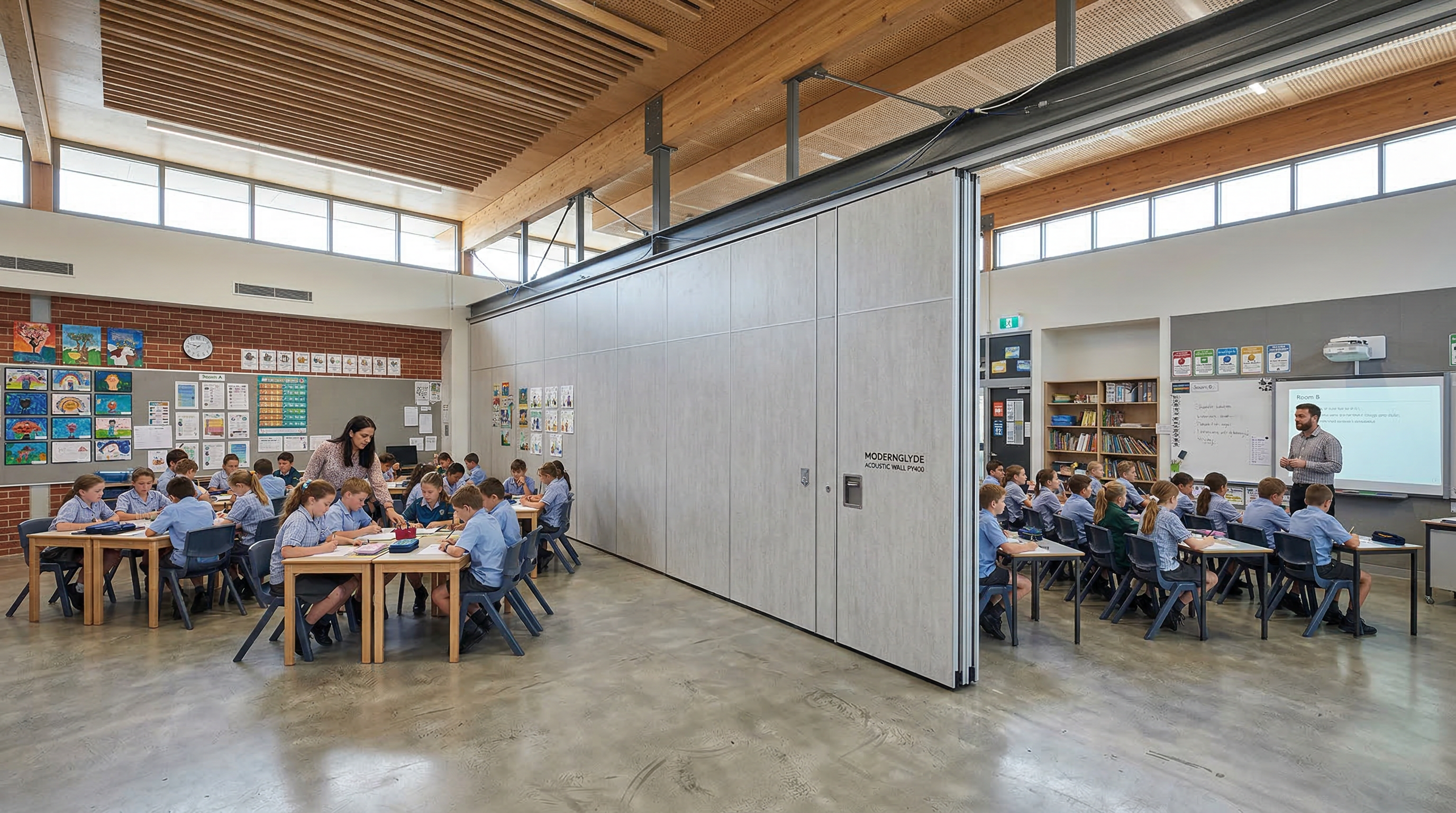
In a primary or secondary school, a divided hall is rarely used by a single group. When a hall is split so that Reception and Year 6 — or a nurture group and a full year cohort — occupy adjoining spaces at the same time, supervising staff must keep clear sightlines over every pupil. This is a daily safeguarding reality that a university lecture theatre never has to solve. ModernGlide systems can be specified with glazed vision panels and configurations that let a partition physically separate age groups and activities while a duty member of staff still sees across the whole space.
School halls also turn over faster than almost any other building. The same room may host a whole-school assembly at 9am, PE and exams through the morning, a hot dinner service at lunch, and an after-school club by 3:30pm. Those changeovers are made not by a facilities contractor but by teaching assistants, a caretaker or the site manager, between lessons and within a single school day. Our walls are designed for exactly this: manual panels that a non-specialist can move and lock in minutes, or push-button electric operation where staff need to reconfigure a space repeatedly without lifting.
Finally, spend has to be justified. Maintained schools and academies work to tight capital budgets and must make the case to governors, a business manager or a multi-academy trust estates team — a very different conversation to a university's larger, longer-horizon capital programme. A movable wall earns its place by turning one hall into several usable, timetabled rooms, so we help schools present robust whole-life cost, acoustic compliance and lettings-income arguments that stand up to trust and governor scrutiny.
Typical Applications in Schools
Acoustic Standards
Building Bulletin 93 (BB93) Compliance
Educational buildings in England must comply with Building Bulletin 93 (BB93), which sets out acoustic performance requirements for different types of teaching spaces. ModernGlide movable acoustic wall systems are available with Rw ratings from 33 to 59 dB, allowing specifiers to select the correct system for each application.
Acoustic ratings explainedPanelHush Acoustic Systems
Acoustic Treatment for School Interiors
PanelHush acoustic panels and ceiling baffles are used in schools to reduce reverberation in classrooms, corridors and shared spaces. Made from 75% recycled PET fibre, they are a sustainable choice for new-build and refurbishment projects.
Recommended Products
Systems for Schools
MG100 – Movable Acoustic Wall
Top acoustic performance, Rw up to 59 dB
MG200 – Hinged Folding Partitions
Floor-supported hinged folding partition where ceiling structure is limited
MG100E – Fully Electric Movable Walls
Motorised operation ideal for staff use
MG400 – Sliding Wall Systems
Straight sliding walls and pocket door systems
BB93 Acoustic Compliance
Systems available to meet Building Bulletin 93 acoustic requirements for educational buildings.
Easy Staff Operation
Designed for non-specialist operation. School staff can reconfigure spaces in minutes without tools.
FIS Accredited Installer
ModernGlide is a FIS accredited installer, giving school business managers confidence in our work.
FAQ
Frequently Asked Questions
Common questions from architects, school business managers and contractors specifying movable walls for schools.
What movable wall systems are suitable for school halls?
The MG100 movable acoustic wall is the most widely specified system for school halls. It achieves Rw up to 59 dB, which meets the acoustic requirements of Building Bulletin 93 (BB93) for educational buildings. For schools where ceiling structure is limited, the MG200 floor-supported hinged folding partition is an alternative.
What is Building Bulletin 93 (BB93) and does it apply to movable walls?
Building Bulletin 93 (BB93) is the DfE guidance document that sets out acoustic performance standards for educational buildings in England. It specifies minimum sound reduction requirements for partitions between different types of teaching spaces. ModernGlide movable acoustic wall systems are available with Rw ratings from 33 to 59 dB, allowing specifiers to select the correct system for each BB93 requirement.
What Rw acoustic rating do I need for a school hall partition?
BB93 typically requires a minimum Rw of 40 to 45 dB for partitions between general teaching areas. For spaces adjacent to music rooms, drama studios or sports halls, a higher rating of Rw 50 to 59 dB is recommended. The MG100 at Rw 59 dB provides the maximum available acoustic separation.
How do you maintain safeguarding sightlines when a school hall is divided?
When a hall is split so that different age groups or activities run side by side, supervising staff still need to see every pupil. ModernGlide walls can be specified with glazed vision panels or partial glazing so a duty member of staff keeps clear sightlines across both spaces, while the partition still provides acoustic separation. We work through the layout at design stage so panel positions, doors and vision areas suit your supervision ratios and safeguarding policy.
Can a movable wall be reconfigured by school staff between every lesson?
Yes. School halls turn over constantly — assembly, PE, exams, lunch and after-school clubs can all happen in one room in a single day, and the changeover is usually done by teaching assistants, a caretaker or the site manager rather than a contractor. Manual panels are pushed along the track and locked with a simple handle in minutes, and the electric MG100E lets staff reconfigure repeatedly at the push of a button with no lifting.
How do multi-academy trusts specify movable walls consistently across sites?
For a multi-academy trust, consistency keeps procurement, maintenance and staff training simple across every school. ModernGlide can standardise on a single system, finish palette and acoustic specification across a trust's estate, provide matching NBS specifications and technical documentation for each site, and align service and maintenance under one arrangement — so an estates team can budget, specify and support every school the same way.
Can school movable walls generate lettings income during holidays?
Yes. Because a movable wall turns one hall into several timetabled rooms, schools can hire the space out to community groups, clubs and sports users during evenings, weekends and school holidays. That lettings income is often central to the business case a school makes to its governors or trust when justifying the capital spend, and we can help set out those figures alongside acoustic compliance and whole-life cost.
What is the maximum height and width for a school movable wall?
ModernGlide movable wall systems can be manufactured to suit almost any opening size. Maximum panel heights typically range from 3 to 6 metres depending on the system. Maximum opening widths are virtually unlimited as the track can span any distance. Structural ceiling loading must be confirmed at the design stage.
Do school movable walls require maintenance?
Yes. Like any mechanical system, movable walls benefit from periodic maintenance to ensure smooth operation and consistent acoustic performance. ModernGlide recommends an annual service inspection. A service contract can be arranged at the time of installation.
Explore More
Other Sectors We Serve

Glazed partitions and movable walls for commercial offices
Divisible lecture theatres and seminar rooms
Flexible spaces for events, meetings and activities
Multi-use worship and community hall partitions
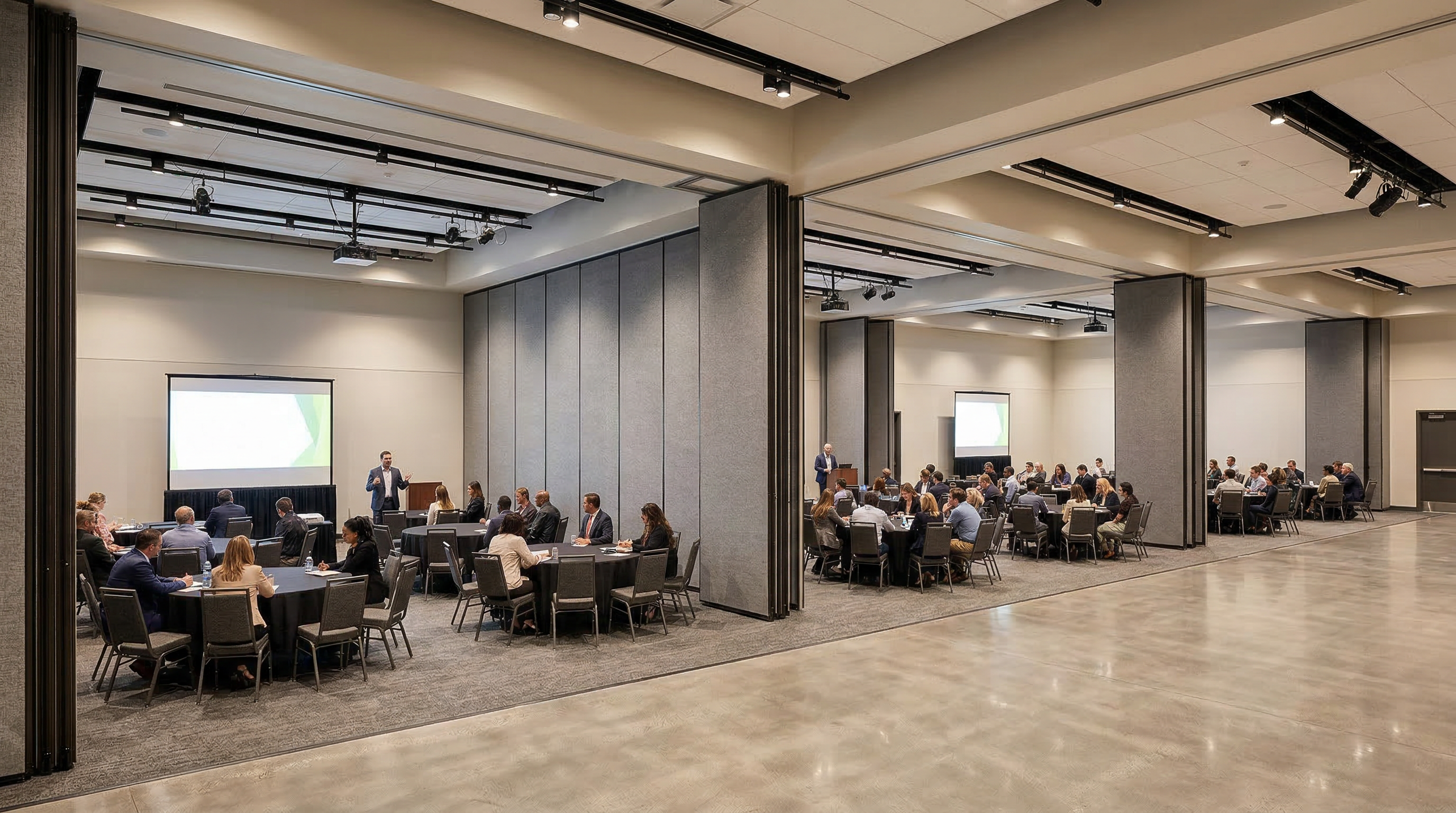
Divisible conference halls for seminars and events
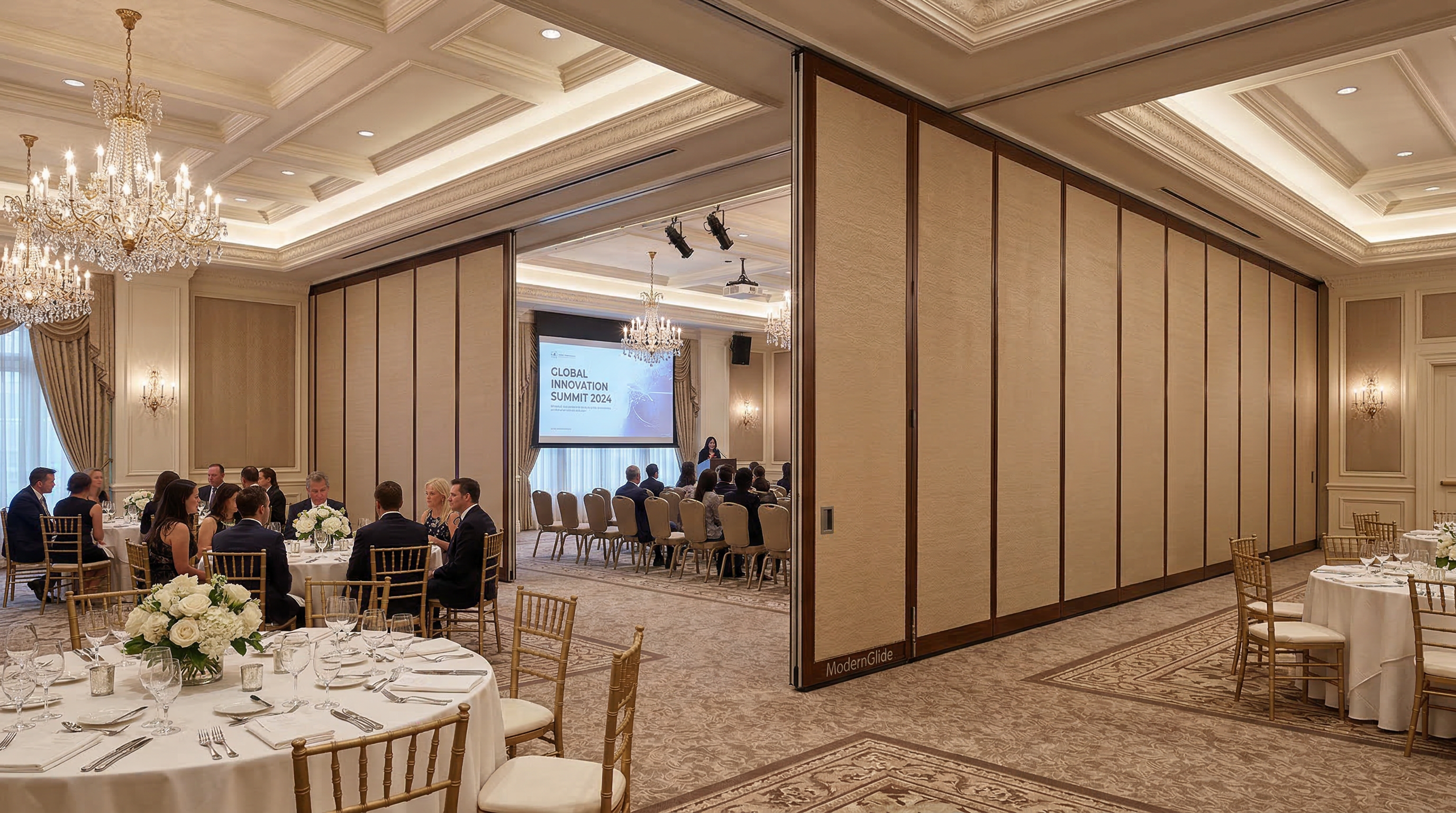
Adaptable banqueting suites and function rooms